

Let’s start this blog with some bald-faced bragging. I am a big fan of Sturgill Simpson. I got to see him live a few years back. It was a good show, a solid flow through the songs, and a top-notch backing band. The only downer was the location, it was in the darkest bar in town, I’m talking about the colour or lack of colour, it was black on black. We managed to get to the rail, sort of. Joel was able to squeeze in with plenty of complaints from a drunk bitch who put the count in country. Remove the o from ‘count’ and you get the gist of what was said. I pushed up behind her and didn’t give her much space. The show was good, I got a poster, and I have all of his albums, except for the last one, which is being shipped soon.
Metamodern Sounds in Country Music
I listened to this album twice yesterday and once more today, and I still don’t know what to say about it. It’s not that there is a lack of things to write about; this album is packed with moments that spark the little electrical current running from my ear to all the little parts of my brain that turn those signals into music, memory, and emotion.
The album starts with “Turtles All The Way Down,” a concept borrowed from Indian gurus who teach that there is no top or bottom; it is turtles all the way down. References are made to encounters with Jesus, the Devil, and Buddha, to the songwriter’s mortality, and to the life-saving effect of love. All of this is within the loose application of a country and western tune. Very loosely, and that is the glory of this album, it does not stick to one plot line or melody line. The songs on this album range from the purest form of traditional country to those that would be right at home on a progressive rock album. If variety is the spice of life, then Metamodern Sounds in Country Music is a spice rack.

Sturgill’s first album was “High Top Mountain“, a straight-shooting collection of songs right out of the same songbook as Waylon Jennings, Merle Haggard, Hank Williams, Lefty Frizzell, and Merle Travis. It is in the spirit of the Outlaw Country ideals, raw and with real musicians, no orchestras or backing choirs. I listened to it once before I spun Metamodern Sounds in Country Music.

And I was blown away. Sturgill Simpson’s second album is not like his first, but it builds on that album and uses it as a framework for Metamodern Sounds in Country Music. I think this is still country music. Is it Country and Western Music? I think so. Americana? Yes, confidently. Wikipedia labels it Outlaw country, progressive country and honky-tonk. Discogs calls it Rock, Folk, World, & Country. It gets tagged ‘Country’ three times between those two sources, so I guess it is ‘Country’ after all.
Country and so much more. This album has enough country to satisfy the C/W purists, including me. And it has enough synths to be a stepping stone to something new and exciting: Metamodern Sounds in Country Music.
This album blew me away the first time I listened to it, shortly after its release. When it came time to hear again in my journey from A to Z, I listened to it three times, and I still don’t know what to write about it. It has to be heard to understand my anguish.
At the end of the day, I am impressed by Sturgill’s nerve to make an album this bold, and I am glad he did.

Next up is Sturgill Simpson’s Best Country Album at the 59th Grammy Awards, A Sailor’s Guide to Earth. Not every artist or band can pull off releasing two albums as influential and as nuanced as Sturgill Simpson has done with Metamodern Sounds in Country Music and A Sailor’s Guide to Earth. Like Metamodern, I had to spin A Sailor’s Guide to Earth three times, and then added a fourth as I listened together with my beautiful wife, Valerie. She doesn’t listen to much music, but I wanted her opinion. She liked it and for good reasons, like the stories within the songs within the overarching drama of A Sailor’s Guide to Earth. We both smiled at his passion for his family and at the good advice he gives his son. A Sailor’s Guide to Earth is another monumental album; you really ought to be listening to it instead of watching the telly. I will add that the covers for Metamodern Sounds in Country Music and A Sailor’s Guide to Earth are lovely, with meticulous artwork on the fold-out cover of the latter. You will not get the impact of the album on a CD or by streaming the album. It is no surprise that he won a Grammy for this album; it is fantastic. It is a flip of the coin to decide whether Metamodern Sounds in Country Music or A Sailor’s Guide to Earth. I like Metamodern Sounds in Country Music for no particular reason. I like it.
SOUND & FURY

Sound & Fury (stylized in all caps) is the fourth studio album by American singer-songwriter Sturgill Simpson, released through Elektra Records on September 27, 2019. An original Netflix dystopian anime film accompanies its release, Sturgill Simpson Presents SOUND & FURY, written and produced by Simpson and Japanese director Junpei Mizusaki of the animation studio Kamikaze Douga. The album marks a significant departure from Simpson’s country roots, embracing hard rock, psychedelic, blues, and funk.
SOUND & FURY is the fourth studio album by Sturgill Simpson, and is a soundtrack to the Netflix anime film of the same name.
Simpson had this to say about the genesis of the album:
“It’s definitely my most psychedelic. And also my heaviest. I had this idea that it’d be really cool to animate some of these songs, and we ended up with a futuristic, dystopian, post-apocalyptic, samurai film.”
“Sound and fury” could be a reference to the famous soliloquy at the end of Shakespeare’s Macbeth, where he says “[Life] is a tale/ Told by an idiot, full of sound and fury/ Signifying nothing.”
Wikipedia says this about SOUND & FURY.
“The album also has a background theme of a silent character listening to radio stations while driving an old muscle car. The album begins during “Ronin” with someone walking up to a car, starting it, and then cycling through an old analogue RF radio tuner, skipping past talk radio channels, before settling on a station with music. This theme continues throughout the entire album, as every track ends with the sounds of static or frequency whistling which typically occurs on old radios while changing stations. This implies that the track changes are actually this unspoken character changing the radio station in their car. “Fastest Horse in Town” bookends the album after the song ends, cycling through random talk radio stations until the radio is turned off completely.”
And now, for something completely different, we move from SOUND & FURY. The most psychedelic and heaviest album in Sturgill Simpson‘s catalogue, to date, and jump to solid Bluegrass. Sturgill has hinted at his passion for Bluegrass and has injected snippets of it in his previous albums. Cuttin’ Grass, Vol. 1: The Butcher Shoppe Sessions is a double album that I had to listen to again because I didn’t want it to end.

Wikipedia again:
“Recorded at the Butcher Shoppe recording studio, the album includes various bluegrass musicians such as guitarists Tim O’Brien and Mark Howard, banjoist Scott Vestal, fiddler Stuart Duncan, and mandolinist/backing vocalist Sierra Hull. The album consists of bluegrass re-recordings of songs from Simpson’s catalogue, including not only those from his solo albums but also those from the band Sunday Valley, of which he was a member before beginning his solo career.”
If you like Bluegrass, you will love this album. If you aren’t a fan yet, Cuttin’ Grass, Vol. 1: The Butcher Shoppe Sessions could make you a fan. It is interesting to hear the songs in either his C/W persona or as a rock star. I didn’t listen to them side by side; however, having listened to them in only a couple of days, my memory of them was still fresh. Listening to them numerous times in these sessions and employing focused listening with lyrics in hand, I did a fair assessment.
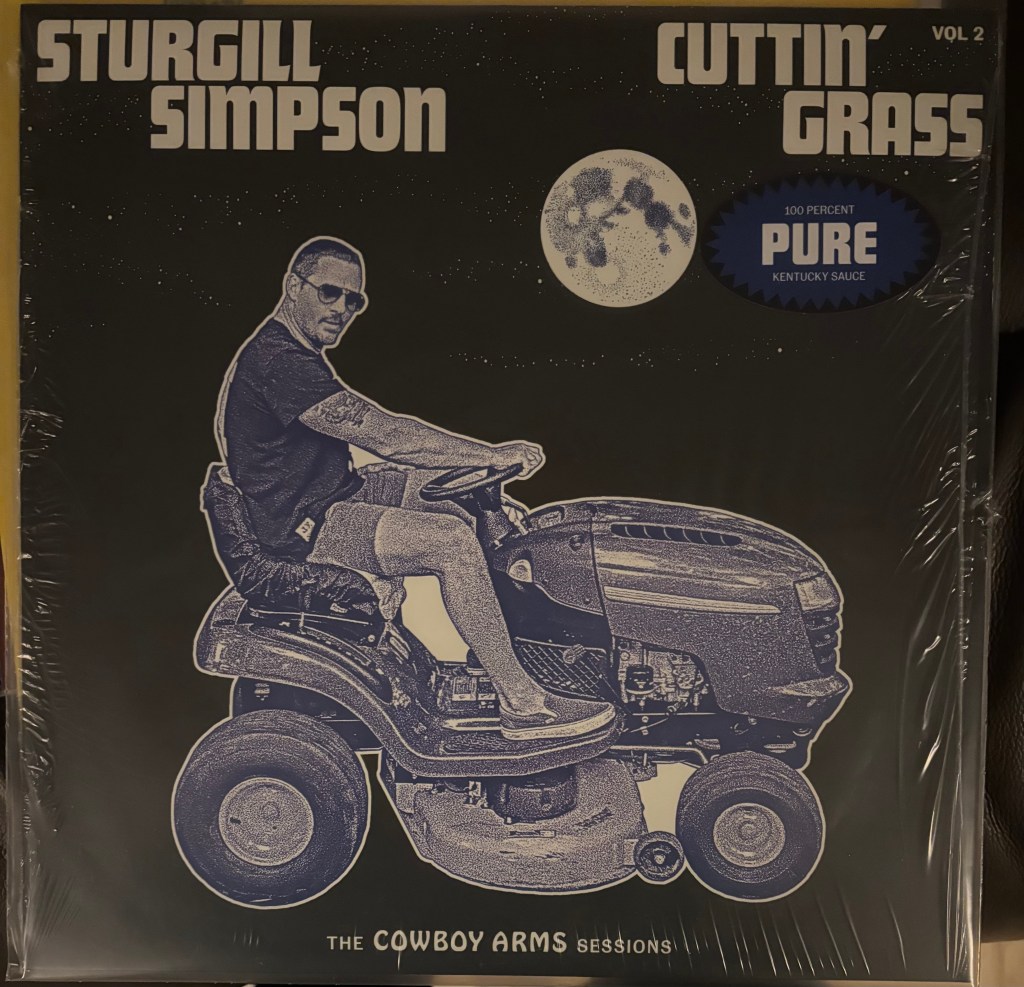
Simpson wasn’t satisfied with the double album; he went up and did another one, Cuttin’ Grass, Vol. 2: The Cowboy Arms Sessions. As with the preceding volume, the album features various bluegrass musicians, including guitarists Tim O’Brien and Mark Howard, banjoist Scott Vestal, fiddler Stuart Duncan, and mandolinist/backing vocalist Sierra Hull. The album consists mainly of bluegrass re-recordings of previously released songs in Simpson’s catalogue. Two previously unheard compositions, “Tennessee” and “Hobo Cartoon,” are included; Merle Haggard co-writes the latter.

The Ballad of Dood and Juanita is the seventh studio album by American country music singer-songwriter Sturgill Simpson, released on August 20, 2021. Simpson describes the album as “traditional country, bluegrass and mountain music, including gospel and a cappella.” Gunfighter Ballads and Trail Songs by Marty Robbins is another album that explores a theme. Simpson wrote and recorded the album in a week with a backing band called the Hillbilly Avengers. Willie Nelson did the concept album “Red Headed Stranger.’ He guests on the song “Juanita.”
The Ballad of Dood and Juanita is a concept album set in eastern Kentucky during the American Civil War. Described by Simpson as “a simple tale of either redemption or revenge”, the album’s narrative revolves around the titular couple: the sharpshooting Dood and his beloved Juanita. When Juanita is kidnapped by an outlaw named Dood, Dood sets out with his mule Shamrock and his dog Sam to rescue her.
I have enjoyed the concept that tells a story. Sturgill has given us The Ballad of Dood and Juanita. The tale of Dude and Juanita follows the script of fighting for love. Seamus lures Dood close to kill him, thinking Dood is out of range, but Dood kills Seamus with a single, long-range shot from his Martin Meylin rifle. Thus ends The Ballad of Dood and Juanita, the last of my stack of Sturgill Simpson records. It’s been a good ride with plenty of twists and turns. Just when you think you have Sturgill sorted out, he makes another turn in the road, and that is one of the reasons I like Sturgill Simpson: you never know what you are getting. So far, I haven’t been disappointed. While each album tells its own story, there is still a thread that gives me a sense of continuity, even when he jumped from the love songs on A Sailor’s Guide to Earth to the rage of Sound And Fury. Tell me what kind of music you listen to, and I can recommend a Sturgill Simpson album.
It’s late, so I am stopping here. I hope you have listened to some good music this week. I am looking forward to next week when I will be listening to a grab bag of music. We will travel from Frank Sinatra to The Smiths. Happy Listening to everyone.
 Weathered Music