
The music this week featured a bunch of guys named Smith, the intersection of faith with music, and my adventures in buying and selling used records.
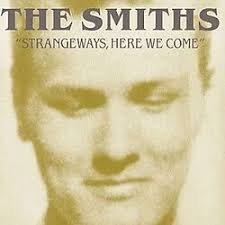
First up, the Smiths, not the band, I listened to Strange Ways Here We Come last week. This week I listened to Arthur, Carl, Hank, and Stuff, a quartet of Smiths. All four of these records came from boxes of assorted records I bought last winter and only just now got around to listening to. The first three also share the genre they play and sing in: Country Music. Stuff played jazz. The C&W albums were released in 1963, 1969, and 1970, respectively, and they showcase the golden era of traditional country and western music. Stretching from the 1940s into the 1970s. Stuff Smith was active from the 1930s until his death in 1967.
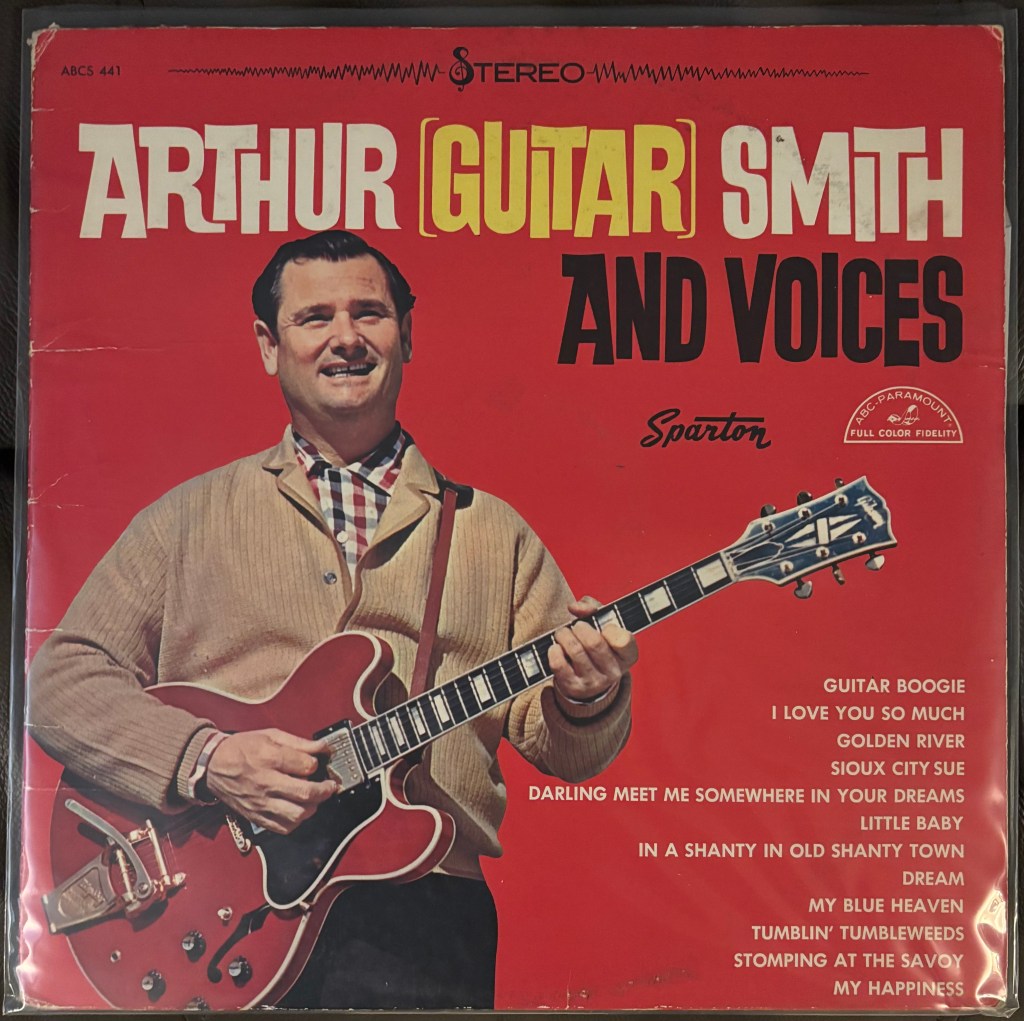
Arthur Smith was a huge success in the 1940s and ’50s, topping charts and pioneering country music broadcasting. The album Arthur (Guitar) Smith and Voices includes tracks showcasing his famous guitar style, alongside vocal numbers, reflecting his work with groups such as his brothers, Sonny and Ralph, in the Crackerjacks. He also wrote the tune that became “Dueling Banjos,” from the 1972 movie Deliverance. The lead track from this album is his signature tune, one of his early hits, the instrumental “Guitar Boogie“, which he wrote and recorded in 1945. It sold over three million copies and was awarded a gold disc by the RIAA. The song earned him the moniker Arthur “Guitar Boogie” Smith. It was recorded by numerous other musicians, including Tommy Emmanuel, and became known worldwide. Renamed “Guitar Boogie Shuffle”, it became a rock and roll hit by Frank Virtue and the Virtues. Virtue served in the Navy with Smith and counted him as a major influence. Other musicians who have been influenced by Smith include Nashville studio ace Hank “Sugarfoot” Garland, Roy Clark, and Glen Campbell.

Carl Milton Smith (March 15, 1927 – January 16, 2010) was an American country singer. Known as “Mister Country“, he was one of the genre’s most successful male artists during the 1950s, scoring 30 top-10 hits on the Billboard charts (21 of which were consecutive). Smith’s success continued well into the 1970s, when he had a charting single every year but one. In 1952, Smith married June Carter, with whom he had a daughter, Carlene; the couple divorced in 1956. His eldest daughter, Carlene, was the stepdaughter of fellow country singer Johnny Cash, who later married his ex-wife, June Carter. He later married Goldie Hill, and they had three children together. This sounds more like a soap opera sketch than a musical tribute. In 2003, he was inducted into the Country Music Hall of Fame. According to the Hollywood Walk of Fame website, he was a “drinking companion” to Johnny Cash, his daughter’s stepfather.
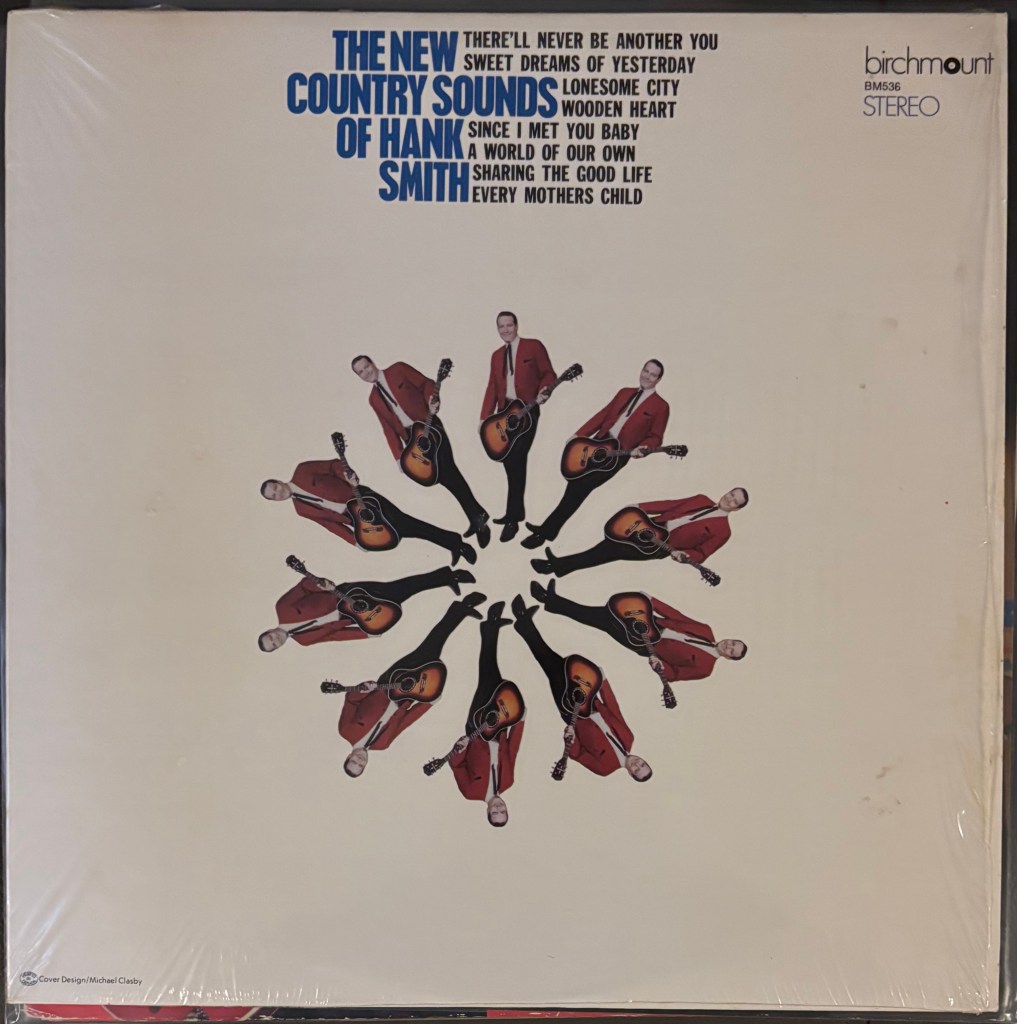
Hank Smith, CM (September 15, 1934 – October 19, 2002) was a Canadian country music singer. He was born in Garmisch-Partenkirchen, Germany, and moved to Canada in 1957. He founded the band Wild Rose Country in 1963 and recorded ten albums. Twelve of Smith’s singles made the RPM Country Tracks charts, including five that went to Number One. Hank Smith was the founding president of the Academy of Country Music Entertainment in 1976, now the Canadian Country Music Association. Smith was appointed a Member of the Order of Canada in 1994.
The music on all three of the above albums made for a very enjoyable day. I was raised on Country and Western music and still listen to plenty of it. As well-known as these gentlemen are, they hadn’t shown up on my radar until this past week. I know them now and will most likely listen to these three albums again.

Stuff Smith lists Stéphane Grappelli as a featured artist on his self-titled album. These are two of the heavy hitters in jazz, swing, and big band violin playing. This is an interesting release because of the different versions available. I have a release from 1969 that lists Stéphane Grappelli as a featured artist in small type below Stuff Smith’s name on the front cover. This album was also released as Stuff and Steff with Stephane Grappelli, with Mr. Grappelli getting equal cover space. There are also about a dozen variants, which makes me glad that I am not a completist; I am happy with the two that I have. I am a fan of jazz violin, and this is a good album to showcase it.
| Arthur (Guitar) Smith | Arthur (Guitar) Smith And Voices |
| Carl Smith | Carl Smith’s Country Music Hall |
| Hank Smith | The New Country Sounds Of Hank Smith |
| Stuff Smith | Stuff Smith |
| Sniff ‘n’ the Tears | Fickle Heart |
| The Little Willies | The Little Willies |
| Jim Weatherly | Pictures & Rhymes |
| Pat Benatar | Greatest Hits |
| King Crimson | In The Wake Of Poseidon |
Sniff ‘n’ The Tears. One song, Drivers Seat.
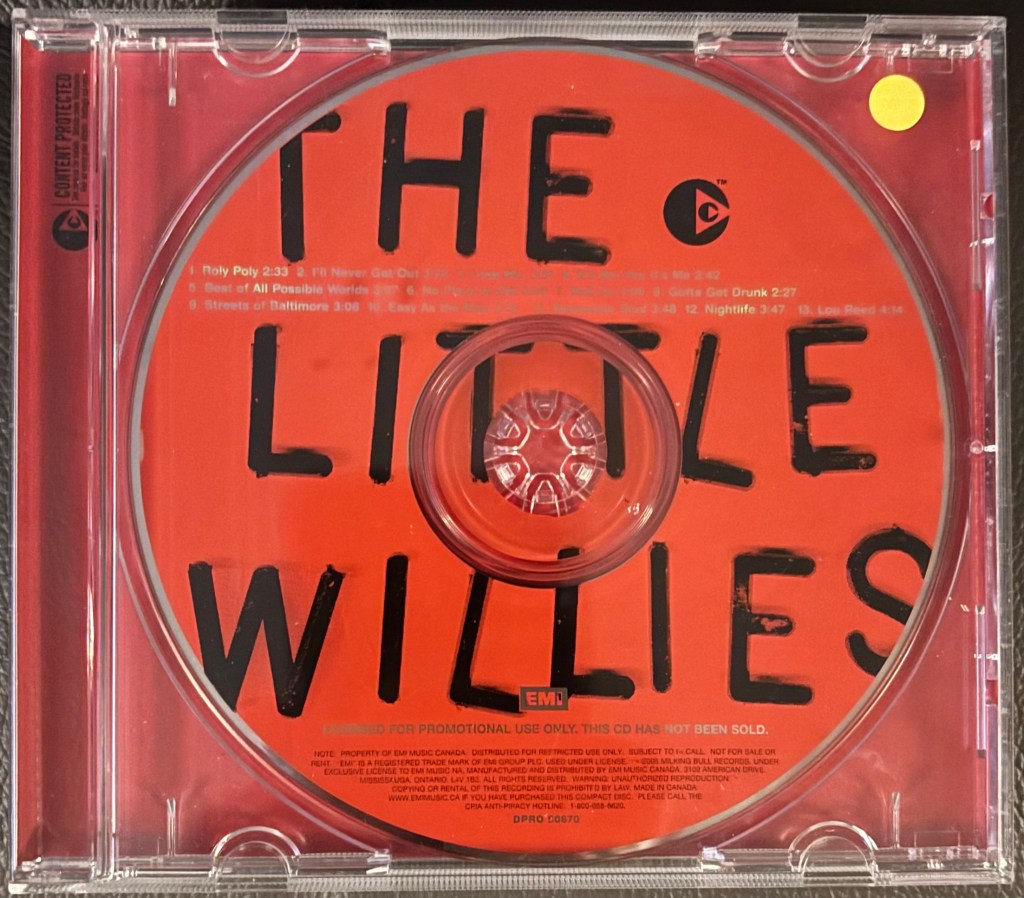
The Little Willies. I had to hear what kind of music a band played that was audacious enough to name themselves The Little Willies sounded like. They sound good.
Wikipedia:
The Little Willies is an American alternative country supergroup formed in 2003. It features Norah Jones on piano, keyboards, and vocals; Richard Julian on guitar, keyboards, and vocals; Jim Campilongo on guitar; Lee Alexanderon bass; and Dan Rieser on drums.
The group formed around a love of country classics. Between members’ regular gigs, they first played at The Living Room in New York City. The show led to a series of events, including a benefit concert for public radio station WFUV. The “loose-knit collective” found itself with a growing following. The Little Willies’ self-titled debut album has added to their popularity.
Their first album features covers of tracks by Fred Rose (“Roly Poly”), Hank Williams (“I’ll Never Get Out of This World Alive”), Willie Nelson (“Gotta Get Drunk” and “Nightlife”), Townes Van Zandt (“No Place to Fall”) and Kris Kristofferson (“Best of All Possible Worlds”). Fusing cover material with a few of their original compositions, the band delivers what a review by John Metzger describes as “an affable set that occasionally strikes pure gold.”
Their second album was released in January 2012 and features covers from a variety of down-home legends, including Johnny Cash, Kris Kristofferson, Dolly Parton, Loretta Lynn, and many more.
My takeaway? I liked it enough to leave it in the car for a week and several trips around the block.
Mostly Wikipedia:

Jim Weatherly wrote songs for almost 50 years. His best-known song is “Midnight Train to Georgia“, recorded by Gladys Knight & the Pips. It peaked at number 1 on the pop and R&B charts and went on to win a Grammy Award. The song was subsequently inducted into the Grammy Hall of Fame in 1999, and was chosen by the National Endowment for the Arts and the Recording Industry Association of America as No. 29 of the 365 Songs of the Century. Ray Price has recorded 38 of Weatherly’s songs. Both Gladys Knight & the Pips (in 1972) and Bob Luman (in 1973) had top-five records with “Neither One of Us“. Other artists who have recorded Weatherly’s songs include: Glen Campbell, Kenny Rogers, Asha Puthli, Neil Diamond, Kenny Chesney, and Garth Brooks. Weatherly was inducted into the Nashville Songwriters Hall of Fame in 2006. Five years later, he was inducted into the Mississippi Musicians Hall of Fame. He was inducted into the Songwriters Hall of Fame in 2014. He was also conferred the Governor’s Award for Excellence in Music by the government of Mississippi that same year.
Plus the fact that I like his name.
Pat Benatar, Greatest Hits. Some radio-friendly songs, not bad, but not my jam.
King Crimson, In The Wake Of Poseidon.

This is the second release from one of my all-time favourite bands, King Crimson. Having discovered In The Court of The Crimson King in 1969, I was happy when they released In The Wake Of Poseidon. It follows the arc of their first album without sounding like a clone. The band had a revolving door during the recording of the album, and no musicians to form a touring band. Fripp keeps the personnel of King Crimson on a Rolodex; you never know who will turn up to play. I was privileged to see King Crimson live in 2015 in Calgary and in 2019 at The Royal Albert Hall in London. In The Wake Of Poseidon is not on my short list of King Crimson’s best albums, but in the top ten. The discography of King Crimson consists of 13 studio albums, 23 live albums, 23 compilation albums, 6 extended plays, 10 singles, 9 video albums, 2 music videos, and 9 album/era-specific box sets. I would have to sell my car and take out a double mortgage on the house to have a complete set of King Crimson material. That’s not going to happen. I am content with what I have.

Kevin from On Repeat Records did post on faith and music that got me thinking, which can be a dangerous thing. My faith, or lack thereof, has deeply influenced my music listening habits. My Mom was a Christian who dragged me to church every so often. I only went because children were taught to obey their parents. My faith was nominal at best. Entering my teens, I was following in my Dad’s footsteps, lacking religious conviction, but with a love of music, something my Mom lacked. I spent the years between my 16th birthday and my 35th in a state of unhealthy life choices, but lots of good music. In 1989, I became a Christian myself and sold off a huge chunk of my record, CD and cassette collection in the mistaken belief that God had some favourite music and I had to listen to the same thing all the other good little Christians were listening to. I regret to this day that I sold all that good music. I have since bought back as many of those albums as I could remember and expanded on the number considerably. So, this past week, I came up with the brilliant scheme to sell off a huge chunk of my record, CD, and cassette collection. I was optimistic that I could trust Discogs‘ value estimations and would soon be rolling in the dough. I then pulled out any records or CDs I wanted to save, let my son pick out some he wanted, and contacted a local record store about selling the music as a lot so I wouldn’t have to sell them one at a time online. And that is when the reality of the value of what was left of my collection settled into the cracks of my brain. I was not going to get rich selling off the music, and I would get more pleasure keeping them and listening to them again. It was when I put the music all back into the alphabet that I realized how much faith had shaped my music over the past 30 or so years. I had amassed over 300 Christian CDs, and probably a similar number of records and cassettes. I didn’t bother to count them all. This is when I read Kevin’s blog at thekevinalexander@substack.com and thought about how music has shaped my listening habits over the years. I have come to believe that faith is not an unwavering line that keeps rising as our faith grows. I feel that faith is more like a sine wave; it moves up and down as our lives and experiences shape our lives and our listening habits. I no longer consider myself a Christian; that’s a much deeper story, and my music listening habits have changed yet again. I listen to a broad palette of music and no longer categorize music as one genre or another. To paraphrase the words of my co-worker, Ernie, “All music is good music, but some is better than others.” Faith and music have intertwined in my life in both small and big ways, but always present, moving and active.
 Weathered Music